Liquid Cooling Cold Plate CNC Machining: Design, Tolerances and Inspection
How to specify CNC machined cold plates for servers, power electronics and AI accelerators: channels, sealing faces, flatness, leak testing and plating.
2026-06-30 · FabVector Engineering
What buyers are trying to solve
Searches for liquid cooling cold plate CNC machining usually come from engineering or procurement teams that already have a CAD model and need a manufacturable route, not a generic machining definition. The decision is normally about material risk, tolerance risk, surface finish, inspection paperwork and whether a supplier can move from prototype to repeat production without changing the process.
Best-fit applications
- Prototype and pilot-run cold plates for GPUs, ASICs, power modules and battery test systems.
- Complex manifold blocks with cross-drilled ports, plugs and gasket interfaces.
- Assemblies that need both thermal performance and leak-tight documentation.
Manufacturing route
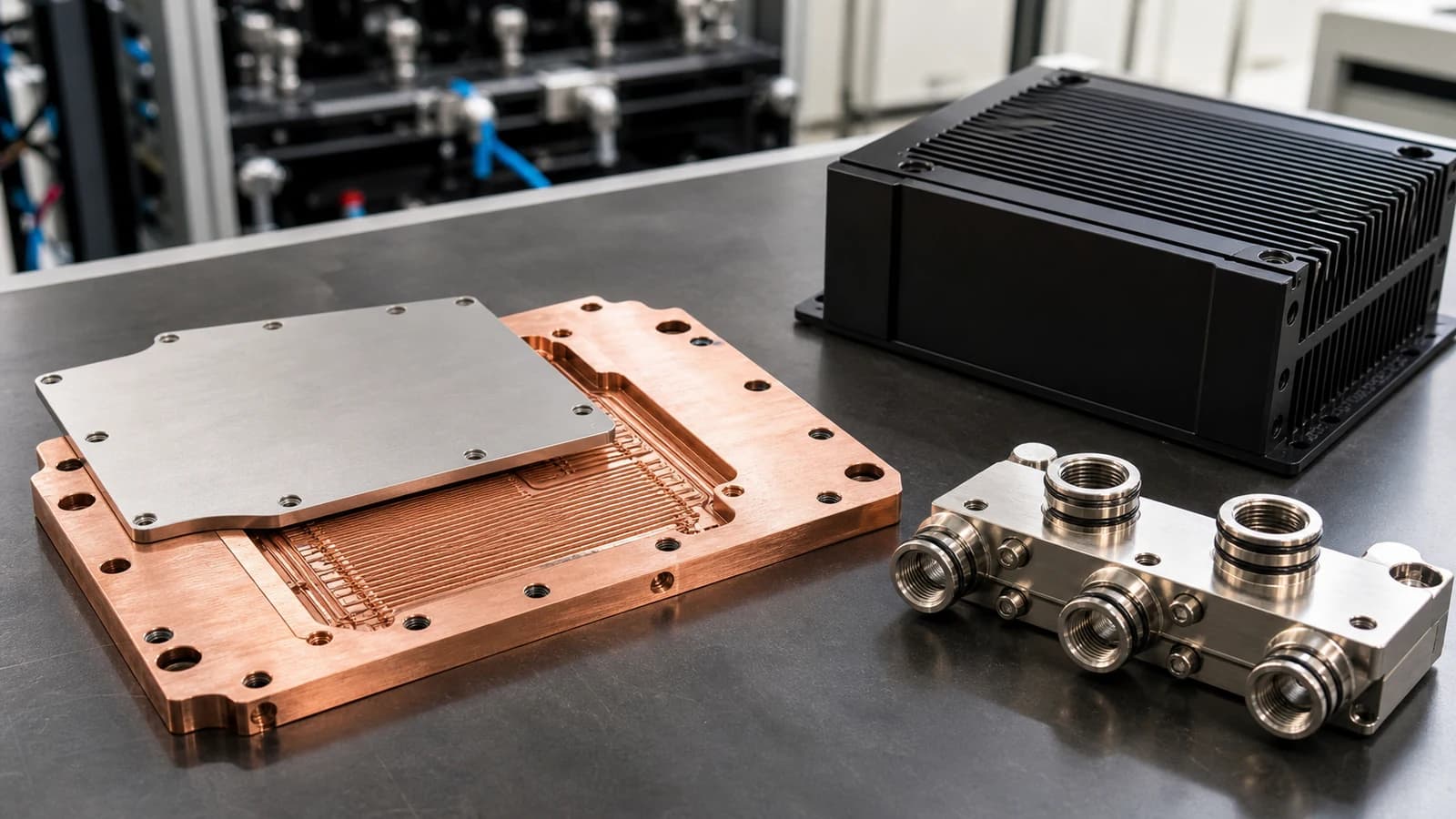
- Machine datum faces first, then internal channels, port features and cover interface surfaces.
- Use secondary operations for plugs, brazing-prep or cover sealing if the CAD design requires it.
- Plan inspection around flatness, O-ring groove width/depth and threaded port location.
Material and finish choices
- Copper C110 for high heat flux zones; aluminum 6061 for lower-mass manifolds.
- Nickel plating or passivation-like cleaning routes when coolant chemistry requires corrosion control.
- Avoid cosmetic-first finishes on thermal faces unless thickness growth is included in the tolerance model.
Risk controls before quoting
- Do not quote only from STL for sealing products; include a drawing with datums and inspection zones.
- Specify whether pressure/leak testing is required and what acceptance threshold applies.
- Flag any area where plating thickness changes channel clearance or O-ring squeeze.
RFQ inputs that improve quote accuracy
- Channel depth, cover strategy, pressure test target and coolant compatibility.
- Flatness and roughness requirements for the thermal interface surface.
- Quantity ladder for prototype, EVT/DVT/PVT or pilot production.
Related FabVector resources
When the part includes thin walls, sealing faces, tight datums, threaded features or inspection requirements, upload the CAD model through the structured RFQ flow so material, finish, tolerance, inspection and delivery expectations stay attached to the same request.
Buyer questions
Questions about this manufacturing route
What matters most when sourcing liquid cooling cold plate CNC machining?
The critical inputs are CAD revision, material grade, tolerance stack, surface finish, quantity, inspection scope and delivery target. Missing any one of these usually creates quote revisions later.
Can FabVector quote from a STEP or STL file?
Yes. STEP and STL can start the structured RFQ. Drawings, GD&T, material certificates and inspection requirements should be attached when the part has regulated or tolerance-critical features.
What process route is usually reviewed first?
Machine datum faces first, then internal channels, port features and cover interface surfaces.
What documentation can be requested?
CMM inspection, FAI, CoC, material certificates, traceability records and packing photos can be requested when the project requires them.
Related resources
RFQ next step
Turn this requirement into a quote package.
Upload CAD, select material, finish, tolerance, inspection and delivery context. FabVector keeps the quote inputs tied to the same engineering request.
Start structured RFQ